Plant and machinery trailers for Australian sites
Plant trailers fail on ramp angle, tie-downs and people who treat ATM as payload. Spec the trailer around the machine’s wet mass and the clay driveway, not the brochure deck length.
By Morgan Blake · 3 November 2025 · Updated 8 June 2026 · 7 min read · 1,439 words
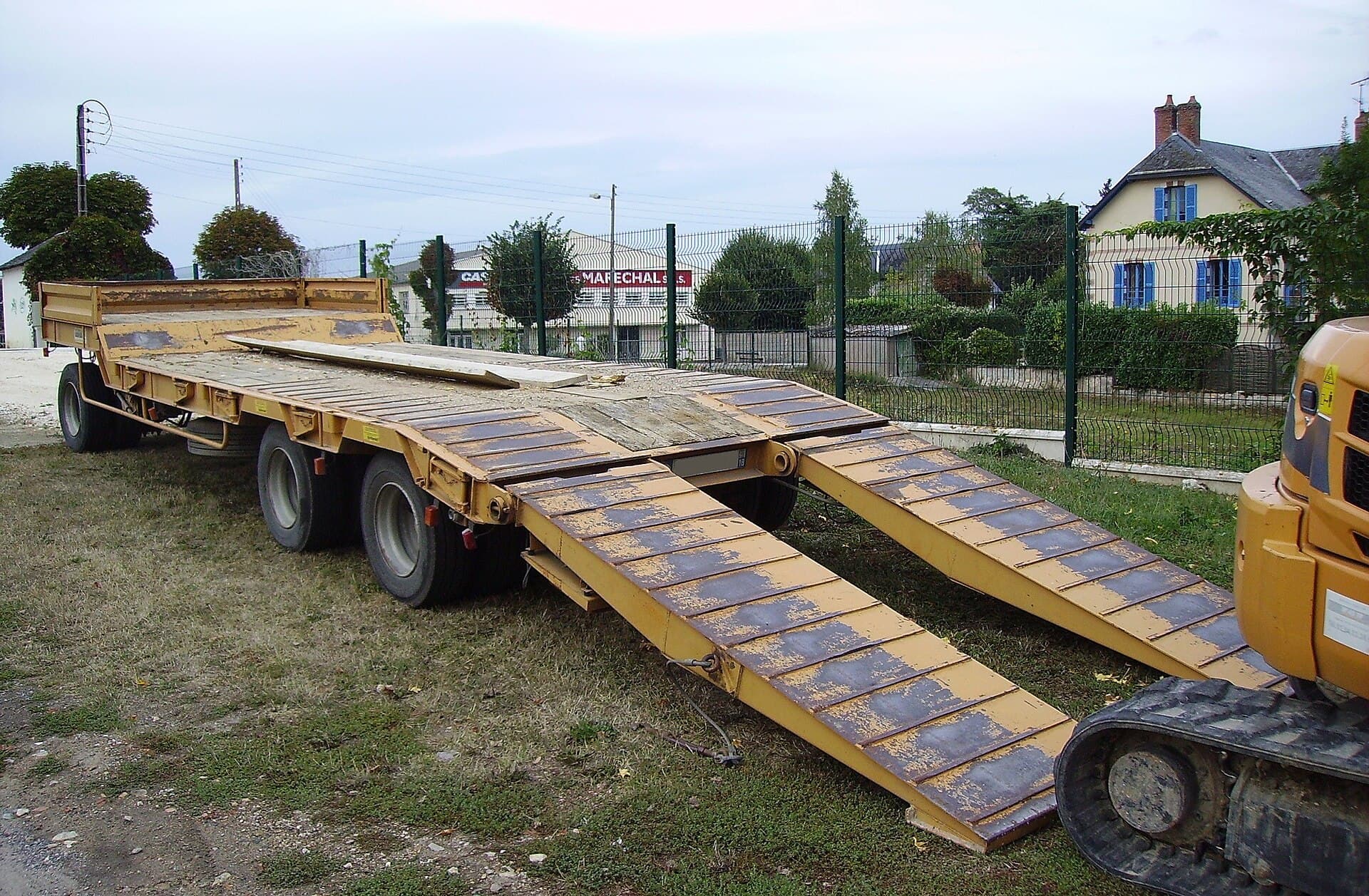
The 1.8-tonne excavator sat at the top of a wet clay driveway in the Hunter and refused to climb the last metre of ramp. The trailer was a “2.5-tonne plant” from a yard that sold deck length. The beaver-tail was too steep once the clay was involved, the hydraulic ramps had already eaten the payload, and the ATM on the plate was the machine’s dry brochure mass plus a wish. Plant trailers in Australia do not fail because they are too short. They fail because someone treated ATM as payload, and because the ramp angle was drawn for a dry concrete pad that no civil site actually has.
A machinery trailer is a loading machine that also has to travel. Spec the ramp, the tie-down pattern and the plate around the heaviest machine you will load on the worst driveway you use.
Payload is not the number on the gate
ATM is the loaded limit of the trailer. Tare is the empty trailer, including ramps, winch, toolbox and the steel you added so the ramps would not bend. Payload is the gap. A 3,500-kilogram ATM tag trailer that tares 1,400 kilograms with hydraulic ramps and a front box has 2,100 kilograms of payload, not 3,500. The 2.0-tonne excavator with a hitch, a mud bucket and a full tank is already a conversation.
Read ATM, GTM and tare the way a roadside inspector will. GTM is the mass on the trailer axles when the coupling is on the ball. A long machine that sits aft can shove GTM while the ATM still looks comfortable. Weigh the machine if the seller’s “1.7 tonne” is a model name. Weigh the trailer. Weigh the combination after a practice load at the yard, not after a 6 a.m. start on a client’s lawn.
| Machine | Typical wet mass | Trailer notes |
|---|---|---|
| Ride-on / zero-turn mower | 250–600 kg | Ramp angle and deck width; easy to hang over the sides |
| 1.2–1.8 t excavator | 1,200–2,000 kg | The Australian default; ramps and ATM both lie if you let them |
| 2.5–3.5 t excavator | 2,500–4,000 kg | Dual-axle, serious GCM, often a truck conversation |
| Vibratory roller | 1,000–2,800 kg | Hates steep ramps; wants a tilt or a long beaver-tail |
| Mini loader / Dingo-type | 900–1,800 kg | Tie-down points that match the machine, not a generic ring |
If you hire plant, spec the trailer for the heaviest machine the desk will send. Hire fleets swap buckets. The plate does not care that the last job was a 1.5.
Ramps, beaver-tails and the driveway that is never dry
A level deck with short steel ramps is cheap and miserable for anything with a long wheelbase or a low belly. The break-over at the top of the ramps is where rollers and mowers dent a client’s concrete.
A beaver-tail drops the last section of deck so the ramps can be shorter and the climb kinder. It adds steel, which is tare. It also needs a length that still leaves the machine’s mass in the right place over the axles. A beaver-tail that is too short is just a steep ramp with extra welding.
A tilt-tray pivots the deck so the machine drives on with a shallow angle. Good for rollers and low mowers. The pivot, the hydraulic ram and the locks are all maintenance, and they are all mass. A tilt that creeps on the highway is a different kind of field note.
Hydraulic ramps on a fixed deck save your back and add the most optimistic tare in the brochure. Manual ramps are heavier to handle and lighter on the plate. Either way, subtract them from payload.
Field note: A civil contractor in Toowoomba bought a tidy tandem with hydraulic ramps for a 1.7-tonne excavator. The ramps and a chequer-plate toolbox put tare at 1,250 kilograms on a 2,500-kilogram ATM. The excavator with a mud bucket sat at 1,860. They used it for six weeks, then a TMR officer and a portable scale ended the argument. The toolbox came off. The next trailer was a 3,500-kilogram ATM with manual ramps and a written payload.
Ramp length is a site spec. A wet clay driveway, a raised timber kerb, or a nature strip the council still owns will change the angle. Test-load on the worst surface you actually use. A dry workshop floor will flatter every trailer.
Tie-downs, winches and machines that walk
Plant walks. Tracks walk. A roller will creep. Four rated chain points that match the machine’s own tie-down points are the minimum, plus a pattern that stops the machine climbing forward under brakes. A single strap over a roll-bar is how you decorate a highway.
Winches belong on trailers that load dead machines or machines that will not climb a wet ramp. Spec a winch with a real rating, a cable or synthetic you will inspect, and a mount that does not fold the drawbar. The winch is not a tie-down. Once the machine is on, chain it as if the winch were not there.
Chassis design on a plant trailer is a load-path problem. Crossmembers have to sit under track loads, not just under a plywood floor. C-channel and RHS choices change how the deck flexes when a 2-tonne excavator puts one track on the edge while it lines up. Ask the builder where the tracks will sit, and whether those rails are doing structural work.
Flooring is usually steel chequer or timber over crossmembers. Chequer plate takes a steel track and announces every wet morning with a slip. Timber is kinder on small rubber tracks and it will be destroyed by a steel-track excavator in a season. Choose for the machine, then accept the maintenance.
Brakes, width and the line into oversize
Useful plant trailers are over 750 kilograms ATM and need brakes. Tandems that carry excavators want electric brakes and a controller the driver has practised with. Over 2,000 kilograms ATM, the breakaway has to work. When a trailer needs brakes is the threshold piece; do not let a yard talk you onto override drums under a 3-tonne ATM “because it is simpler”.
Width is the quiet way a plant trailer becomes illegal. A mower deck, a set of forks, or an excavator that sits a little wide can push you over general-access width. Oversize and overloaded trailers is the companion piece. The NHVR publishes the national mass and dimension framework; states still run the roadside. If the machine hangs over, you do not have a tarpaulin problem. You have a permit or a different trailer problem.
Match the trailer to the tow vehicle with GCM after the tray is full of buckets, a fuel drum and three extra chains. A one-tonne dual-cab with a 3,500-kilogram tow rating is not automatically a 3,500-kilogram plant prime mover. Some combinations belong on a truck. That is not a failure of nerve. It is reading two plates.
Lights get smashed by ramps. Spec recess-mounted LED lamps and a plate that stays visible with the ramps up. Lights, reflectors and number plates still apply when the trailer is filthy; ADR compliance is the legal frame if a builder shrugs.
Steel, rust and the site that never rinses
Plant trailers live in mud and coastal fill. Galvanising after welding survives; powder coat over raw steel looks like a hire fleet for three months. Preventing rust means drain holes and not storing clay against a chassis rail. Steel versus aluminium is usually steel for plant — alloy decks save tare on mower trailers and do not love steel tracks.
Couplings are a 50-millimetre ball on lighter tags and a pintle on some heavier combinations. Height-match so the deck is level. A used plant trailer that has been overloaded and advertised as “2.5-tonne” needs a structural look, not a wash. A custom build should start with wet masses, the worst driveway and GCM — questions for manufacturers should mention ramp angle and payload after ramps. Budget the system, then put bearings and ramp pins on a yearly schedule.
Next step
Write the heaviest machine’s wet mass, the worst driveway angle you use, and the GCM left on the tow vehicle after the tray is loaded. Take those three numbers to a builder and ask for payload after ramps, in writing. If you want the legal edge of that conversation — width, mass and the roadside — start with oversize and overloaded trailers and do not leave the yard on a hope.
Questions readers ask
- What size plant trailer do I need for a 1.7-tonne excavator?
- Start with the excavator’s operating mass plus a bucket, hitch and a full fuel tank, then add the trailer tare and a margin. A 1.7-tonne machine on a trailer that tares 900 kilograms is already a 2,600-kilogram conversation, not a 2,000-kilogram ATM hope. Ramp angle and tie-down points decide whether that mass can get on and stay on.
- Are beaver-tail and tilt-tray trailers the same thing?
- No. A beaver-tail is a fixed deck that slopes at the rear so ramps can be shorter. A tilt-tray pivots the whole deck. Hydraulic ramps are a third option on a level deck. Each changes how a roller or a low-clearance mower climbs, and each adds tare you have to subtract from ATM.
- When does a plant trailer become oversize?
- When width, length, height or mass steps over the general-access limits for your state and the national heavy-vehicle framework. A wide mower deck or a machine that hangs over the sides can put a “small” trailer into oversize territory even when ATM is legal. Check the plate and the [NHVR](https://www.nhvr.gov.au/) mass and dimension material before you leave the yard.
- Do I need electric brakes on a plant trailer?
- If ATM is over 750 kilograms, you need brakes. Most plant trailers that can carry a useful machine are well over that, and many sit over 2,000 kilograms ATM where a breakaway is also required. Electric brakes with a cab controller are the usual spec once you are in tandem and machinery masses.